

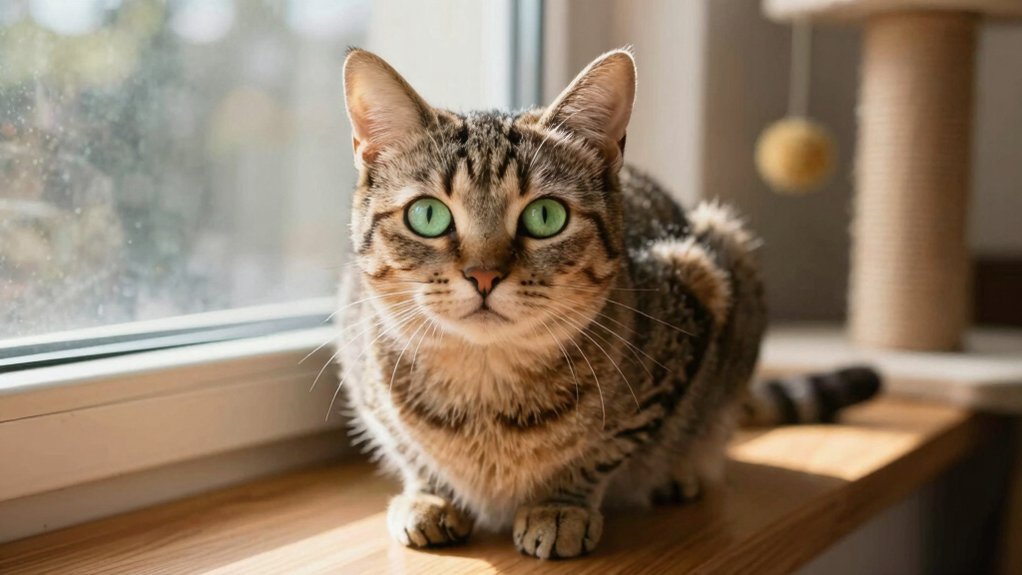
You’ll learn practical, evidence-based cat facts to improve care and connection: they sleep 12–16 hours and dream in REM, each nose print is unique, whiskers measure openings, and they can jump six times their height. Their night vision and tapetum aid low-light hunting, ears hear up to ~64 kHz, tails balance and signal mood, paw pads are highly sensitive, and they often recognize your voice; keep going to uncover more useful insights.
Disclosure: This post may contain Amazon affiliate links, at no extra cost to you. Content on Pawtangle is created with research support from AI tools and carefully reviewed, edited, and fact-checked by the lead author, Dr.Fahri Pat , to ensure accuracy and reliability. Learn more
Key Takeaways
- Cats sleep 12–16 hours daily, spending about 70% of their life resting, often dreaming during REM sleep.
- Their whiskers and flexible spine enable precise spatial judgment, extreme agility, and safe righting during falls.
- Cats see in very low light thanks to dense rods and a reflective tapetum lucidum, enhancing night vision.
- They hear up to ~64,000 Hz, detecting high-frequency sounds humans cannot, aiding prey detection and awareness.
- Communication relies on body language (tail, ears, slow blinks) and selective vocalizing mostly directed at humans.
Cats Can Sleep Up to 16 Hours a Day
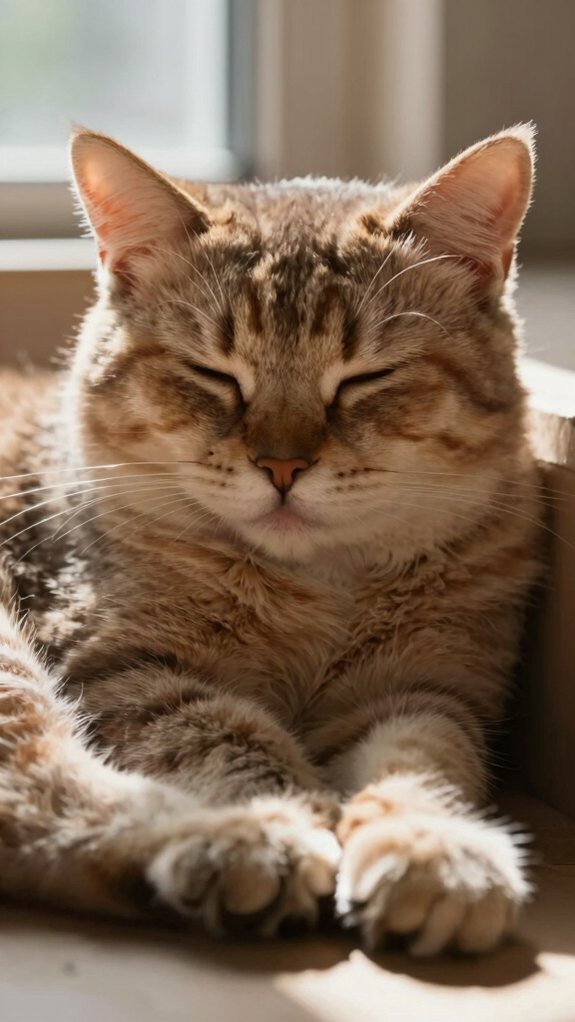
Cats often sleep 12 to 16 hours a day, a pattern rooted in their crepuscular biology and energy-conserving hunting instincts. You observe that about 70% of a cat’s life is spent sleeping, so their sleep patterns matter for health. You’ll understand sleep as strategic: stages include REM, supporting mental and physical restoration, and brief wakeful bursts ready the cat for dawn and dusk activity. Compared with dogs, cats favor longer rest due to solitary-hunter evolution. You belong to a community that honors these needs; by respecting their rhythms you promote wellbeing and shared trust through informed care.
A Cat’s Nose Print Is Unique
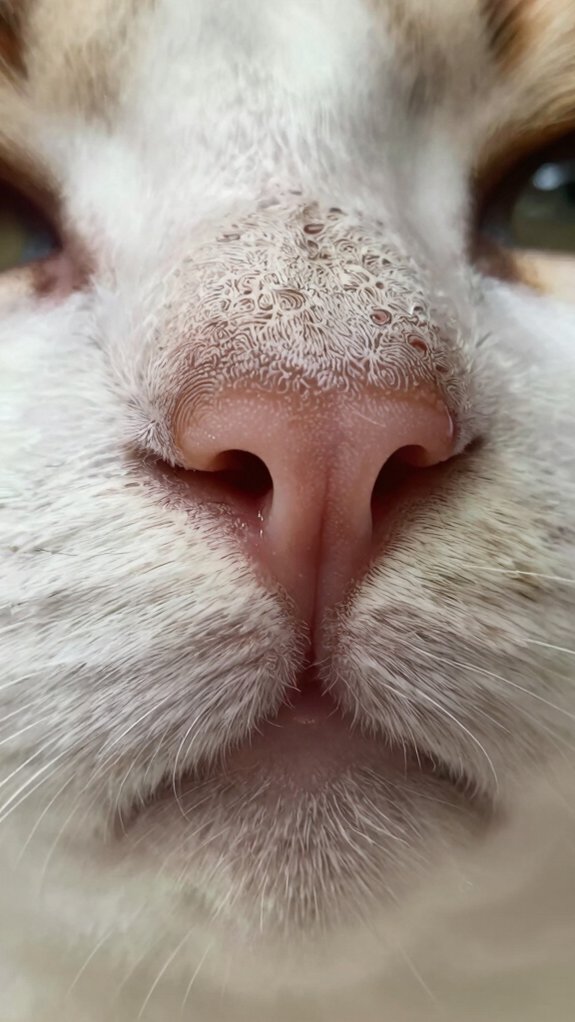
While their sleep patterns reveal much about feline physiology, other subtle markers—like the nose—tell stories about individual identity. You’ll notice each cat’s nose print is unique, a pattern of ridges and bumps useful for nose print identification and gentle proof of belonging. Veterinarians compare prints to confirm identity or ownership; the structure also supports scent detection, linking form to function in feline biology. You’ll feel reassured knowing this quiet individuality exists. It’s precise evidence of who your cat is, and it encourages connection when you recognize that singular, living signature.
| Feature | Relevance |
|---|---|
| Uniqueness | Identification |
| Structure | Scent function |
Cats Use Whiskers to Measure Space
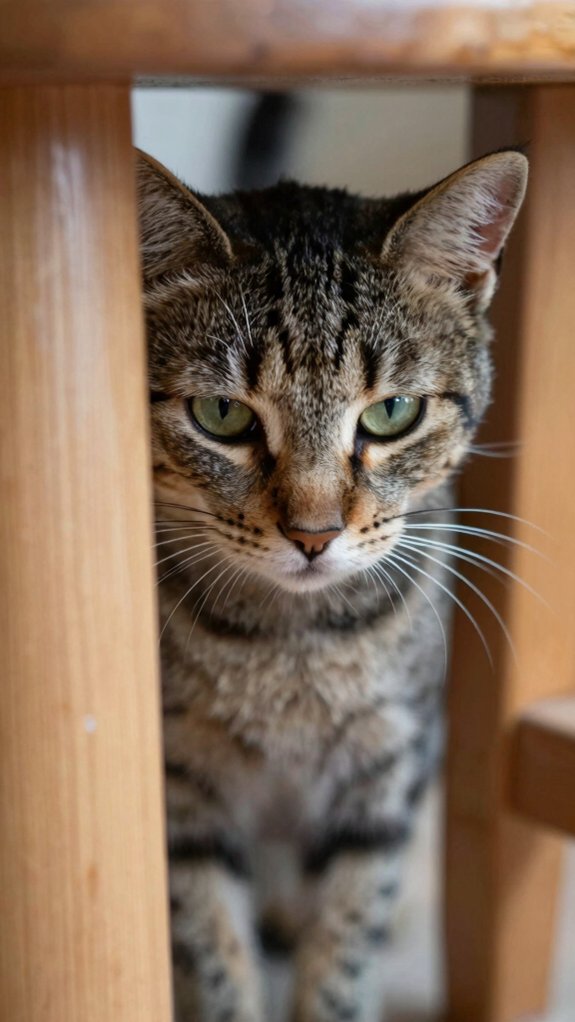
Whiskers are precision instruments that let your cat gauge openings and nearby objects with remarkable accuracy, their length roughly matching body width so your cat can judge whether it can pass through a gap. You’ll notice whisker sensitivity guides exploration: specialized hairs detect subtle air currents and contact, giving reliable feedback while measuring spaces. Carpal whiskers on the front legs add localized sensing as your cat probes edges. Because whiskers can overstimulate, you should provide varied, comfortable routes and perches to reduce fatigue. Respecting this sensory system helps your cat feel safe and included in your shared environment.
Cats Can Jump Six Times Their Height
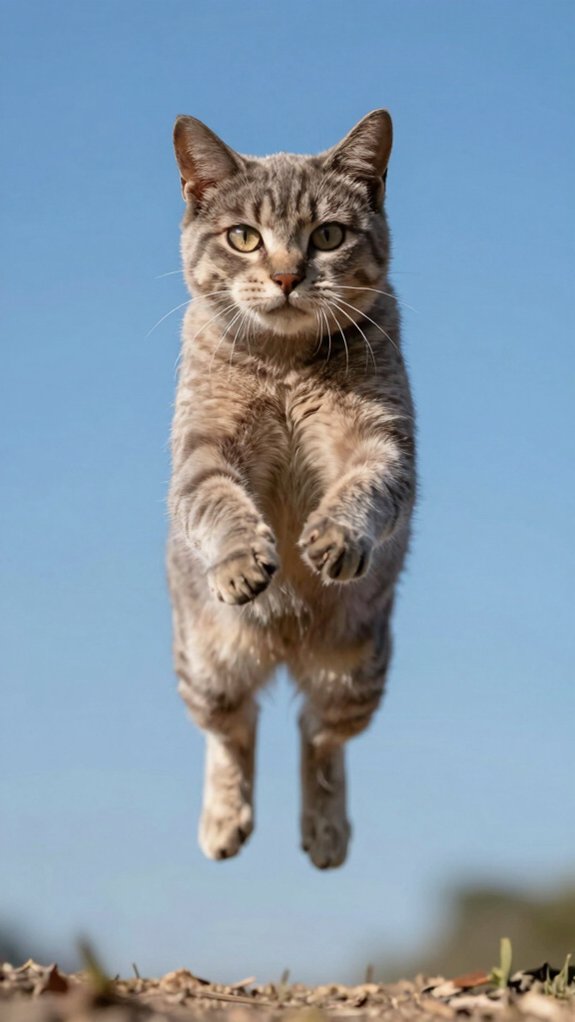
Because they combine strong hind-leg muscles with a hyperflexible spine, your cat can propel itself impressive distances—often up to six times its body length. You’ll notice this strength during play and when practicing jumping techniques learned instinctively; younger, fitter cats usually reach higher peaks. This capacity reflects evolutionary design: muscle-tendon storage, rapid extension, and spinal articulation coordinate to create efficient bursts. Those bursts provide clear hunting advantages and escape options, so you should respect energy needs and offer safe vertical spaces. Observe without startling, support conditioning through play, and celebrate how this athleticism connects you to your cat’s wild heritage.
Cats Have Powerful Night Vision
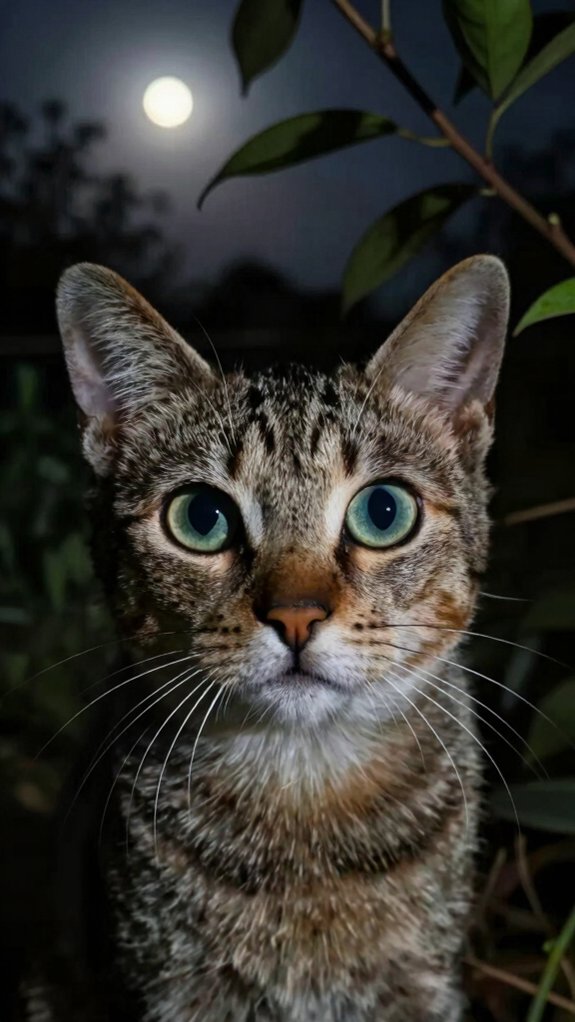
Although their eyes look gentle in dim light, cats see far better than we do at night: they detect motion and shapes in light levels about six times lower than what a human needs, thanks to a high density of rod cells, a reflective tapetum lucidum behind the retina, and relatively large eyes that gather more light. You’ll notice how night vision modifications support their hunting techniques: they detect subtle movement, orient quickly, and close distance confidently. You belong with others who respect this skill.
| Feature | Benefit |
|---|---|
| Rod cells | Low-light sensitivity |
| Tapetum lucidum | Light reflection |
| Large eyes | Light acquisition |
| Nearsightedness | Close-range focus |
Cats Communicate with Slow Blinks

When a cat meets your gaze and slowly closes its eyes, it’s offering a deliberate, affiliative signal often called a “slow blink” or “cat kiss” that communicates trust and comfort; responding with a slow blink of your own can reinforce that bond. You should recognize slow blinking as purposeful, nonthreatening communication that signals contentment and safety. Because direct eye contact can feel aggressive, this gentle exchange lets you share cat affection without overwhelming the animal. Reciprocating teaches the cat you respect its cues, strengthening mutual trust. Observe frequency, context, and body language to interpret intent and deepen belonging.
Cats Purr to Relax and Heal
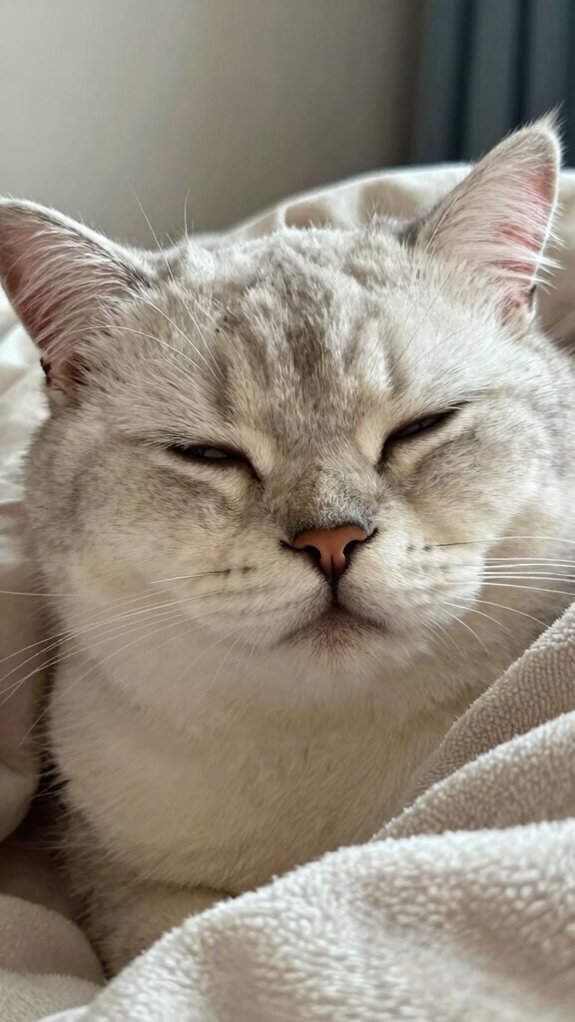
You can see a slow blink as an invitation to closeness, and purring often serves as the quiet, physiological companion to that social signal. You notice purring benefits in lowered stress and blood pressure for both you and your cat; those healing vibrations span roughly 25–150 Hz and correlate with tissue regeneration. When cats purr during pain or distress, they’re engaging a self-soothing, therapeutic behavior that also supports bone and muscle recovery. This habitual vocalization contributes to feline emotional health and to your shared sense of safety, offering clinical reassurance and compassionate belonging in everyday moments.
Cats Hear Higher Frequencies Than Humans
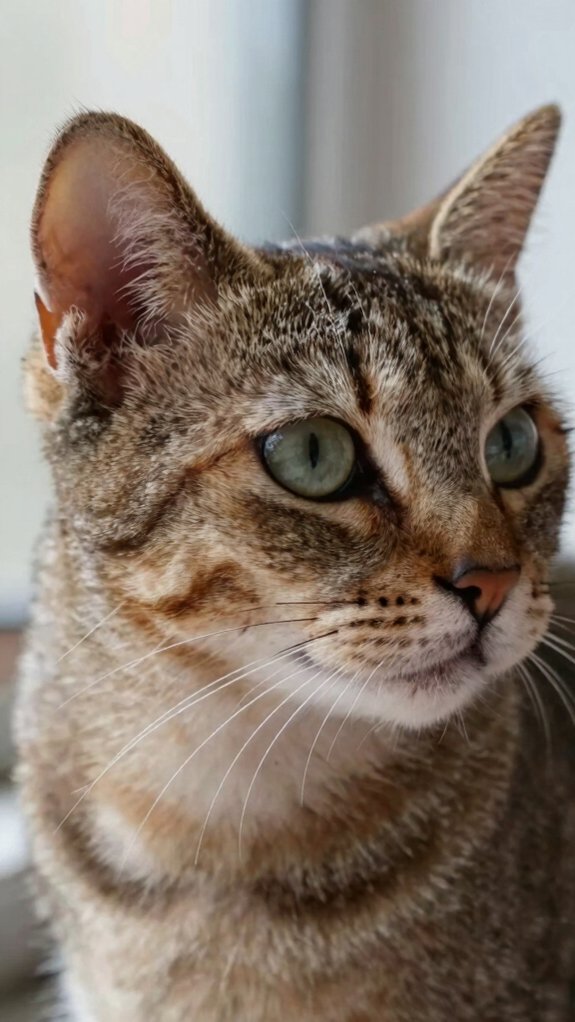
Because cats can hear frequencies up to about 64,000 Hz—well beyond the human limit of roughly 20,000 Hz—they pick up high-pitched sounds you can’t detect, which helps them locate small prey and assess their environment. You notice your cat reacting to ultrasonic dog whistles or faint electronics; that’s superior sound detection at work. This acute hearing gives them an evolutionary advantage for hunting and threat assessment, improving survival odds. Speak and act with understanding when your cat reacts to invisible noises; you’re part of a community that respects these instincts and supports their well-being with informed care.
Cats Can Rotate Their Ears Independently
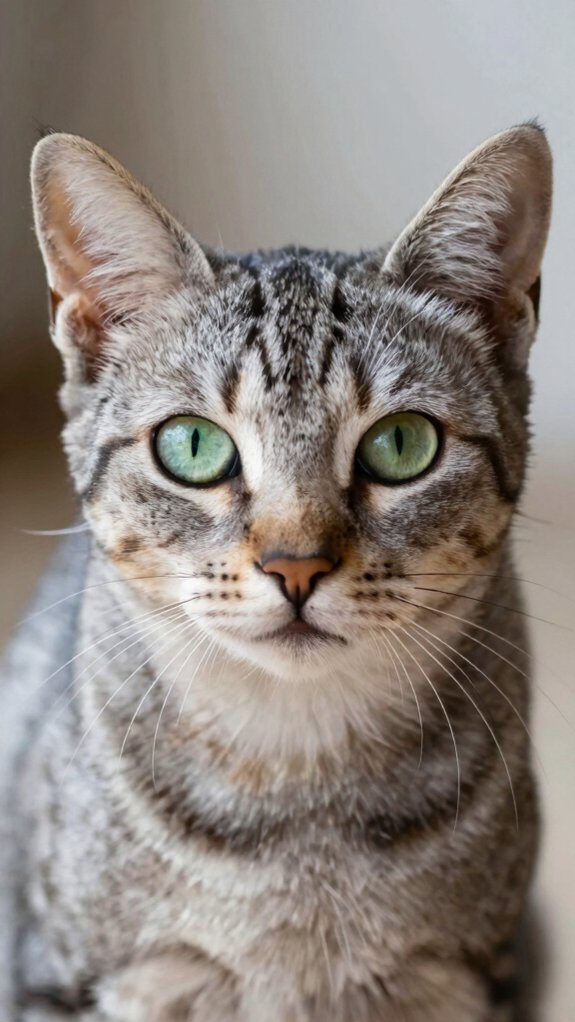
Although their faces stay still, a cat’s ears are constantly working—each ear contains about 32 muscles that let them swivel independently up to 180 degrees, so they can pinpoint sounds with remarkable precision without moving their heads. You’ll notice they can rotate ears 90 degrees forward or backward, enhancing ear mobility and enabling improved sound localization. This lets them track prey, attend to multiple cues at once, and stay alert to threats without obvious movement. Appreciate how this subtle skill connects you to their instinctive competence; it invites you into a shared respect for their sensory world and quiet efficiency.
Cats Rarely Meow to Other Cats

While domestic cats meow frequently to get your attention, they seldom use that vocalization with other cats, relying instead on scent, posture, and touch to convey messages. You learn that Meowing behavior is a domestication-driven tool for human-directed requests; wild and feral cats favor scent marking and body language. This knowledge deepens your bond, letting you respond compassionately to varied vocal cues. Feline communication spans subtle gestures and social odors, so you’ll watch posture as carefully as sounds.
| Scent | Posture | Touch |
|---|---|---|
| markers | ear position | grooming |
| territory | tail flag | brushing |
Cats Have a Flexible Spine
When you watch a cat twist midair or squeeze through a narrow gap, you’re seeing the result of a spine built for extreme flexibility: up to about 30 vertebrae, no rigid collarbone, and specialized muscles and ligaments that let the animal bend, rotate, and absorb impact with remarkable precision. You observe spinal flexibility that supports a righting reflex and lets the cat land feet-first after falls. This anatomy yields clear agility benefits: long jumps, tight squeezes, and sure-footed movement across varied terrain. You feel connected to these capabilities, recognizing how evolution and care combine to keep your cat safe and capable.
Cats Use Their Tail for Balance
A cat’s tail serves as a flexible counterbalance that lets the animal stabilize its body during walking, running, jumping, and tight turns. You’ll notice tail agility in quick turns and high jumps; the tail aids the righting reflex so your cat lands safely. You’ll also read tail communication in posture: upright signals confidence, tucked signals fear. This helps you respond with calm care, strengthening your bond. You observe balance in narrow spaces, where the tail guides adjustments. Below is a concise reference you can use to appreciate and support your cat’s movement and emotional signals.
| Action | Role | Signal |
|---|---|---|
| Walk | Balance | Neutral |
| Run | Stabilize | Raised |
| Jump | Counterbalance | Splayed |
| Turn | Adjust | Flick |
Cats Can Recognize Their Owner’s Voice
Because your cat has learned the sound patterns of your speech through repeated interaction, it can distinguish your voice from strangers and often shows subtle signs of recognition rather than immediate obedience. You notice quiet turns of the head, ear swivels, or delayed approaches that signal owner recognition and selective voice response. Those behaviors reflect social bonding, not simple training. You respect their choice to respond on their terms, which deepens connection. Evidence shows recognition ties to socialization and individual temperament, affirming intelligence and distinct communication styles. You’re part of a relationship built on mutual trust and attentive exchange.
- Ear swivels as acknowledgment
- Delayed approach patterns
- Context-dependent vocal cues
- Bonding influences recognition
Cats Have Sensitive Paw Pads
Although they might look soft and simple, your cat’s paw pads are densely packed with nerve receptors that make them exceptionally sensitive to touch and environmental changes. You’ll notice paw pad sensitivity when they withdraw from rough surfaces or relax under gentle handling; allowing you to touch their feet signals trust. Paw pad functions include sweating for minor cooling, shock absorption when they land, and scent marking for social communication. You care for them by keeping pads clean and checking for injury. Below is a quick reference:
| Function | Purpose |
|---|---|
| Sensation | Detect touch/environment |
| Cooling | Sweat glands |
| Protection | Shock absorption |
| Communication | Scent marking |
Cats Can Dream While Sleeping
Those sensitive paw pads you inspect for cuts also belong to an animal that spends about 70% of its life asleep and regularly enters REM sleep, the stage linked to dreaming. You’ll notice twitching, paddling, or quiet vocalizations—signs of dreaming behavior mirroring daily pursuits like stalking or cuddling you. REM-associated brain activity suggests these sleep patterns support memory, learning, and emotional processing. Appreciate that dreaming reflects neurological development and mental health; it connects you to your cat’s inner life and nurtures belonging. Observe gently and protect restful routines to support healthy sleep.
- Twitching limbs
- Vocal murmurs
- REM brain activity
- Memory consolidation
Frequently Asked Questions
Do Indoor Cats Need Different Diets Than Outdoor Cats?
Yes — you should adjust diets: indoor nutrition focuses on controlled calories, fiber and weight management, while outdoor activity needs higher calories and protein; you’ll balance health, prevent obesity, and support your cat’s lifestyle with compassion.
How Do I Tell if My Cat Is in Pain?
Listen closely — you’ll notice subtle shifts: vocalization changes, withdrawn body language, reduced grooming, limping or hiding. Trust your instincts, stay calm, comfort them gently, and see your vet quickly for confirmation and care.
Can Cats Get Bored Living Alone?
Yes — your cat can get bored living alone. You’ll observe boredom signs like lethargy, overgrooming, vocalizing, or destructive behavior. Prioritize cat companionship, structured play, and environmental enrichment to support emotional and behavioral wellbeing.
Are Certain Breeds Hypoallergenic for Allergy Sufferers?
Yes — some breeds seem less reactive, though no cat’s truly allergen-free. You’ll find Siberian breeds often show lower allergen levels, so you’ll want trial exposure and empathy to confirm your personal tolerance and belonging.
How Often Should Kittens Visit the Vet?
You should take kittens to the vet every 2–4 weeks until about 16 weeks for initial vet checkups and kitten vaccinations; afterward, schedule annual exams, and connect with a caring clinic that supports you and your kitten.