
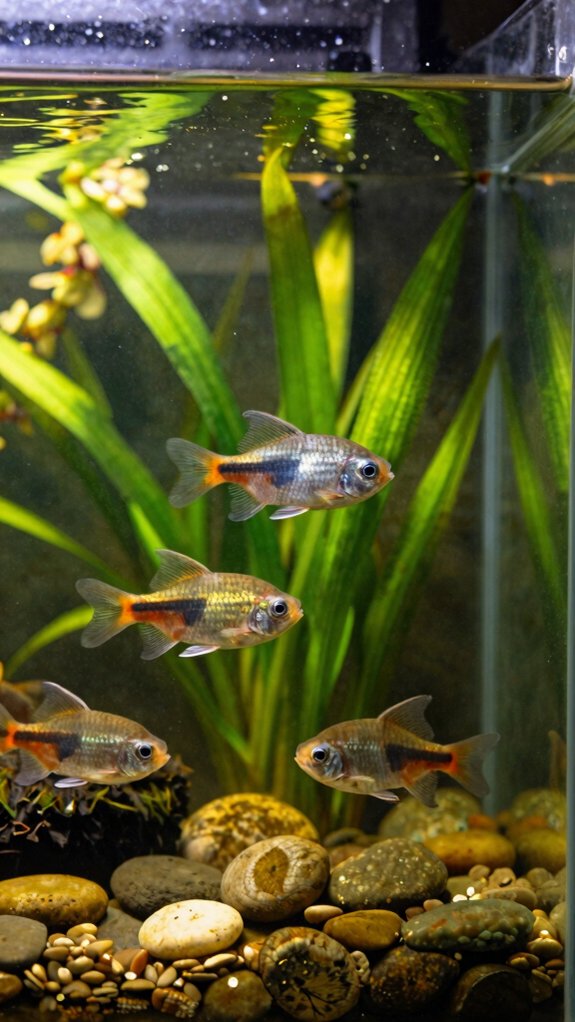
Gourami fish are colorful, mostly peaceful freshwater pets, with popular types like dwarf, honey, pearl, and giant gourami. They do best in a calm tank with plants, hiding spots, gentle filtration, and warm, clean water around 75 to 82°F. Good tank mates include tetras, rasboras, and peaceful catfish, while fin nippers and aggressive fish should be avoided. Feed varied flakes, pellets, and frozen foods, and keep stress low; more helpful care tips are just ahead.
Disclosure: This post may contain Amazon affiliate links, at no extra cost to you. Content on Pawtangle is created with research support from AI tools and carefully reviewed, edited, and fact-checked by the lead author, Dr.Fahri Pat , to ensure accuracy and reliability. Learn more
Key Takeaways
- Popular gourami types include dwarf, honey, pearl, and blue gouramis, with giant gouramis suited only to large tanks.
- Use a planted tank with floating cover, hiding spots, and open swimming space; 10 gallons suits one dwarf gourami.
- Keep warm, stable water: 72–82°F, pH 6.0–7.5, zero ammonia and nitrite, and low, gentle filtration.
- Feed a varied omnivorous diet of quality flakes or pellets, plus frozen or live foods like bloodworms and brine shrimp.
- Choose peaceful tankmates like tetras, rasboras, and Corydoras, and avoid fin-nippers and aggressive fish.
What Are Gourami Fish
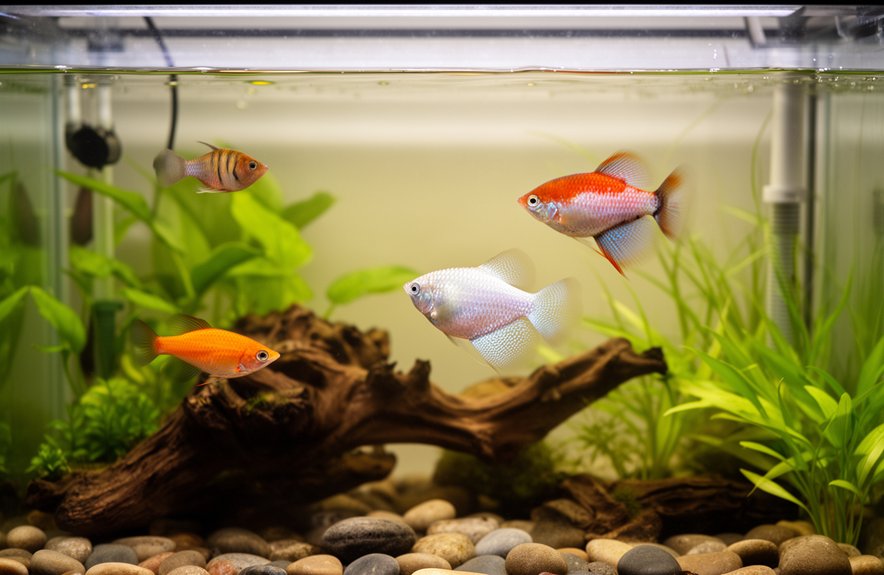
Gourami fish are a group of freshwater fish known for their special labyrinth organ, which lets them gulp air from the surface and live in low-oxygen waters. Their labyrinth anatomy helps them cope in shallow ponds, slow streams, and other wild habitats where oxygen can run low.
They belong to the Osphronemidae family and include species that stay small or grow quite large. Many have calm, social behavior, though some can become territorial. They eat insects, larvae, crustaceans, and plants, so a varied diet keeps them in good shape and feeling at home.
Popular Gourami Types
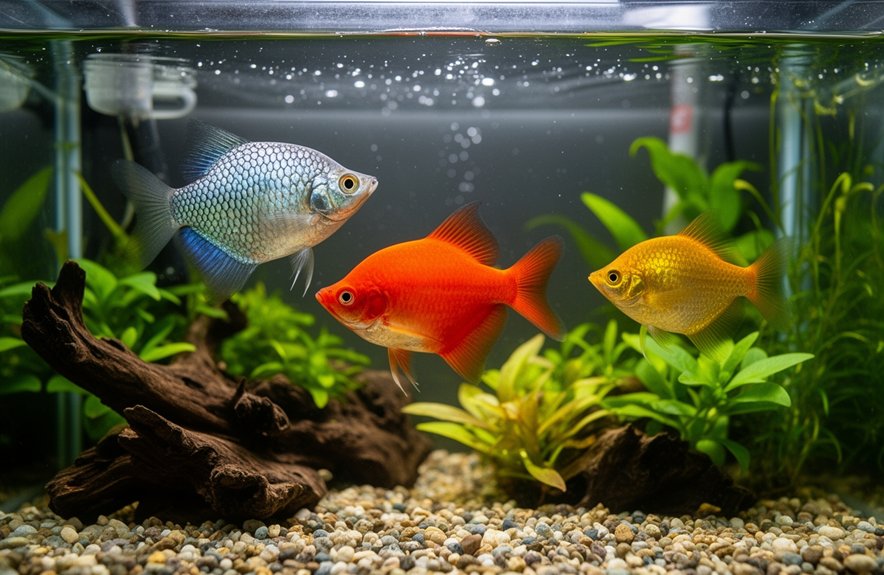
Dwarf and Honey gouramis suit smaller, planted tanks, while Pearl gouramis bring a lace-like look and Blue gouramis are sturdy, easygoing fish for many home aquariums.
Picking the right one usually comes down to tank size, water space at the surface, and how much activity the keeper wants in the tank.
Dwarf Gourami
Small and lively, the dwarf gourami adds a bright splash of color to a home aquarium, and it usually stays around 3 inches long. Its dwarf gourami genetics can affect color and health, so careful buying matters.
As an anabantoid, it uses labyrinth organ physiology to gulp air at the surface, which helps in warm, gentle water. A planted tank of at least 10 gallons, with floating cover and 72–82°F water, suits it well.
Males may guard territory, so one male, or distinctly divided spaces, keeps the peace. Feed flakes, pellets, and frozen foods, and the little showoff usually thrives.
Honey Gourami
Honey gouramis offer a calmer, smaller option after the brighter dwarf gourami, and they fit nicely into planted community tanks.
At just 1.5 to 2 inches, they suit 10-gallon or larger setups, with warm water, gentle filtration, and floating plants that help them feel at home. Males grow golden-orange and more pointed fins, while females stay paler and rounder, so sexing is usually easy.
They eat flakes, micro pellets, and small frozen or live foods, and their peaceful nature suits tetras and rasboras. Watch breeding behavior and male squabbles, since one male per small tank supports better captive longevity.
Pearl Gourami
Among the most eye-catching gouramis, the pearl gourami stands out for its lace-like white spotting and calm nature.
This peaceful labyrinth fish grows about 4 to 5 inches, and selective breeding has helped keep its pattern vivid.
A planted tank with floating plants, soft light, and open surface space suits its Labyrinth organ, which needs easy air access.
Keep water at 72–82°F and pH 6.5–8.0, with at least 10 gallons for a pair, though larger homes help reduce breeding squabbles.
Feed flakes, pellets, bloodworms, and brine shrimp to keep color and condition strong.
Blue (Three-Spot) Gourami
The blue, or three-spot, gourami is one of the most familiar gourami choices, and it has a hardy build that makes it a good fit for many home aquariums.
This peaceful-looking fish grows to 4–6 inches, breathes air with a labyrinth organ, and shows several color morphs, including metallic blue, opaline, and gold.
- Keep it in 20+ gallons
- Use 72–82°F water
- Aim for pH 6.5–7.5
- Add plants and floating cover
- Offer flakes, pellets, and frozen foods
Males may guard space and build bubble nests, so one male per tank often keeps the community calm.
Ideal Tank Setup
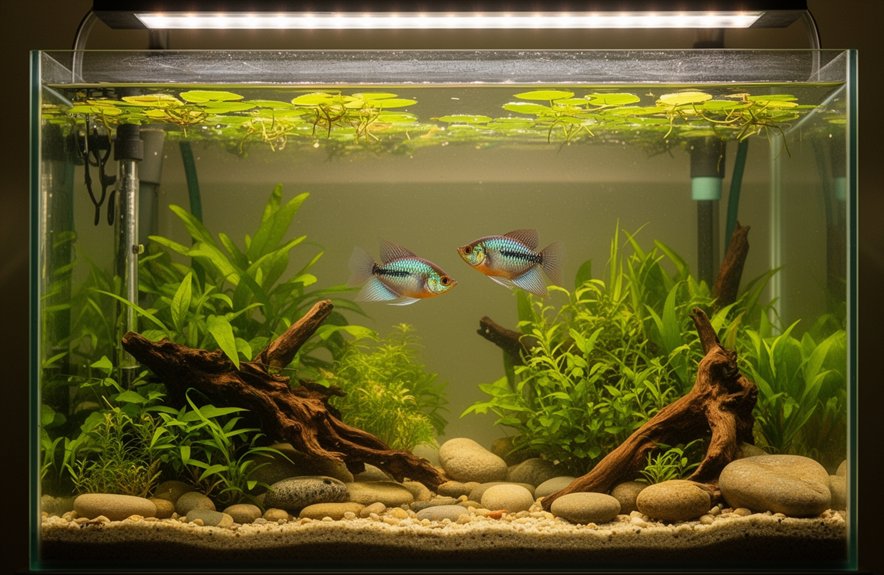
A dwarf gourami does best in a tank of at least 10 gallons, and a pair or small group needs about 15–20 gallons or more so each fish has room to swim and claim space.
The water should stay calm, with gentle filtration and low flow, because strong currents can make these fish uneasy, and soft lighting helps keep the tank feeling peaceful.
Live plants, floating cover, and a few hiding spots finish the setup, giving the gouramis shade, security, and a place that feels more like home than a fish bowl with furniture.
Tank size: 10–20+ gallons
For a dwarf gourami, a 10-gallon tank is the bare minimum, while 15–20+ gallons works better for a pair, several females, or a planted community setup. This size gives room for comfort, tank aesthetics, and seasonal behavior changes.
- A wider footprint helps territory sharing
- Shallow to moderate depth supports easy air access
- Live plants add cover and nesting sites
- Neutral substrate keeps the look calm
- Hiding spots help reduce stress and squabbles
A steady 74–79°F and clean water support daily health. With enough space, the fish settles in more naturally, and the home feels less cramped for everyone.
Low water flow (they prefer calm water)
Low water flow helps gouramis feel at home, especially after the roomier tank setup already gives them space to settle in.
A sponge filter, or a canister filter with a spraybar, can keep movement gentle and calm.
This quiet flow matches their shallow native waters, supports bubble nest maintenance, and leaves peaceful labyrinth breathing spots near the surface.
Aim the current along the tank sides, not at resting or nesting areas.
Gradual water changes matter too, because sudden rushes can unsettle them.
A calm tank is not ostentatious, just friendly, and gouramis usually appreciate that.
Live plants for cover
Among the best parts of a gourami tank, live plants do more than decorate, they give these fish the cover they naturally look for. Floating mats like Water Lettuce and Frogbit soften the surface, while aquatic mosses, Java Fern, and Vallisneria build layered hiding places.
- Shade the top
- Calm nest sites
- Mark territories
- Shelter fry
- Ease stress
A fine substrate with driftwood or leaf litter helps roots and keeps the setup natural. Clear surface space should stay open, so air-breathing gouramis can still reach the top without bumping into a jungle gym.
Soft lighting
In a gourami tank, soft, dappled light works best because it copies the shaded waterways these fish come from and helps keep stress and squabbles down. Low to moderate LEDs or fluorescent fixtures on a timer, about 8–10 hours daily, support plants and keep the mood calm. Floating plants are helpful, and a little ambient filtration prevents glare.
| Choice | Benefit |
|---|---|
| Water lettuce | Softens light |
| Frogbit | Adds surface cover |
| Java Fern | Handles low light |
| Anubias | Stays healthy |
Avoid harsh beams; even gouramis prefer not to feel spotlighted. Nocturnal lighting should stay minimal.
Best Tank Mates
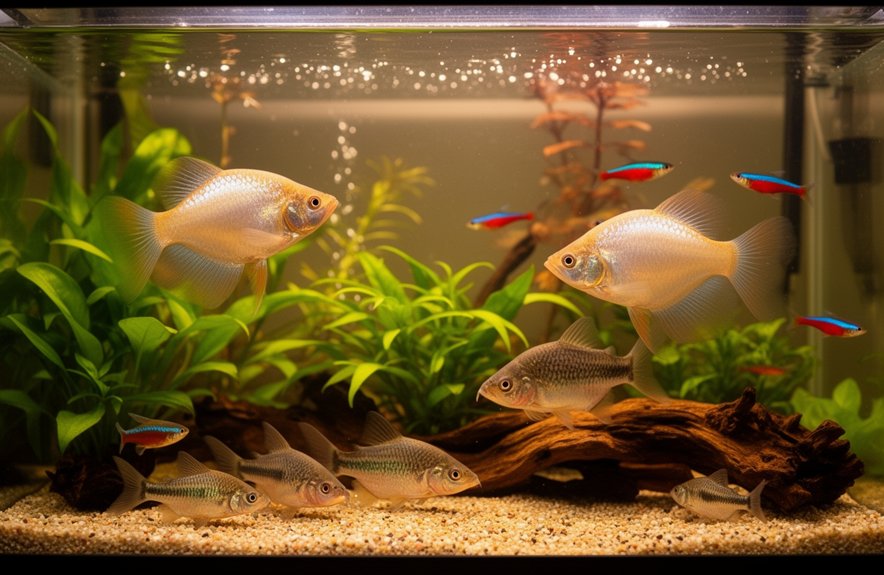
Good gourami tank mates are usually peaceful community fish, such as tetras, Corydoras, and rasboras, because they stay calm and fit well into the same tank.
These fish tend to use different parts of the aquarium, with Corydoras on the bottom and gouramis near the top, which helps keep things orderly.
Small, non-aggressive tank mates are the safest choice, since a calm tank is much easier to manage than one full of constant squabbles.
Tetras
Neon tetras, harlequin rasboras, and ember tetras can make excellent tank mates for dwarf gouramis, because these small peaceful fish stay in the mid-to-upper water levels and usually leave a gourami’s territory alone.
- A neon tetra adds color improvement and calm motion.
- Schooling interactions work best with 6–10 fish.
- A small school fits a 10–20 gallon community.
- Habitat mimicry helps, with 72–82°F water and soft, steady pH.
- Avoid fin-nippers, and feed at two spots so everyone gets a fair share.
This setup helps neighbors feel secure, and the tank stays balanced, bright, and easy to enjoy.
Corydoras
Corydoras catfish make some of the best bottom-dwelling tank mates for gouramis, since they stay small, peaceful, and busy on the substrate instead of competing for the same space. Keep 4–6 together, so the group feels secure and settles into natural schooling, like a little cleanup crew that belongs.
| Need | Good Setup | Why It Helps |
|---|---|---|
| Soft sand | Fine substrate | Protects barbels |
| Group living | 4–6 fish | Reduces stress |
| Night habits | Quiet lights | Supports nocturnal foraging |
| Cover | Plants, caves | Adds safety |
| Water | 72–78°F, pH 6.5–7.5 | Fits gouramis |
A calm 20-gallon community helps everyone share the floor.
Rasboras
Gliding through the middle of the tank, rasboras make some of the best companions for gouramis. Their schooling behavior helps them feel secure, and that steady motion often keeps the aquarium calm. Choose 6–10 fish, ideally 1–2.5 inches long, so they can move safely without becoming a snack.
- Harlequin, Chili, and Lambchop rasboras work well
- Keep water at 74–79°F
- Aim for pH 6.5–7.5
- Use soft to moderately hard water
- Offer flakes, pellets, and small frozen foods
Dense plants, floating cover, and open swimming space support natural breeding behavior and give the group room to belong.
Peaceful community fish
Avoid tiger barbs, large cichlids, and male bettas, since they can spark stress and torn fins.
Dense plants and floating cover help males settle their breeding behavior, while mixed color variations add life without crowding.
Keep shrimp or baby snails with care, because hungry gouramis may sample them.
Avoid
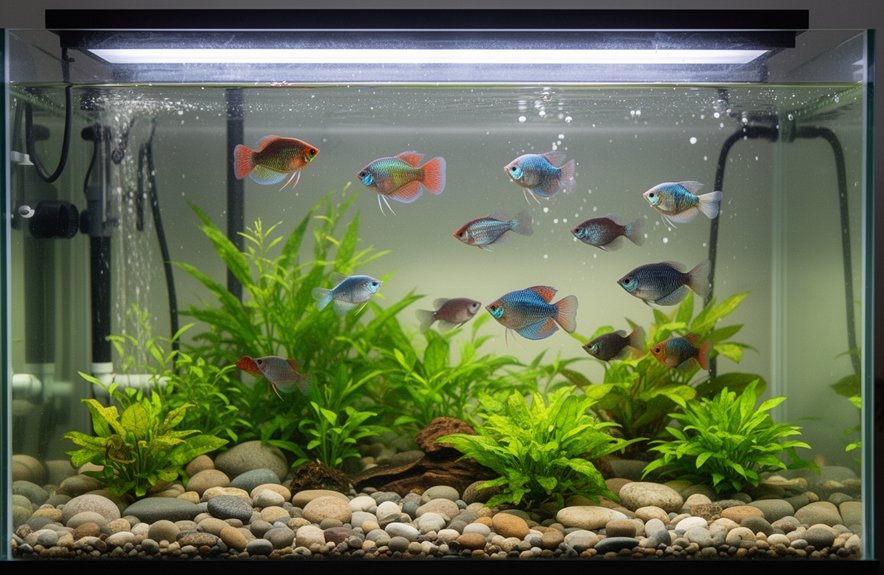
Gouramis do best with calm, peaceful tank mates, so aggressive fish should be avoided.
Fin-nippers like tiger barbs can stress them, damage their fins, and make the tank feel unsafe.
A better choice is a community setup with gentle, steady fish that leave them in peace.
Aggressive fish
When choosing tankmates for dwarf gouramis, calm neighbors are the safest choice, because aggressive fish often turn their flowing fins into easy targets.
Territorial displays from male bettas and paradise fish can quickly stress the group, so shared space should feel peaceful, not like a sparring ring.
- Skip tiger barbs and cichlids.
- Avoid other male labyrinth fish.
- Leave out fast, boisterous feeders.
- Keep shrimp and fry protected.
- Match warm, gentle-water species.
With slow water and a roomy, planted tank, gouramis settle in better, and the whole aquarium feels more like a good neighborhood.
Fin-nippers (may stress gouramis)
Even in a calm tank, some fish bring a little too much edge for gouramis, and fin-nippers are a common problem to watch for. Tiger barbs, some danios, and similar species can tear fins again and again, raising stress indicators and opening the door to bacterial infections.
Long-finned gouramis, including dwarf and pearl types, are especially vulnerable, and their swimming and mating can suffer. In small tanks under 30 gallons, even “peaceful” nippers may shift the social hierarchy with extra bites.
Watch feeding and active periods, and if nipping starts, separate the offender or move gouramis to a planted tank with visual barriers.
Water Conditions
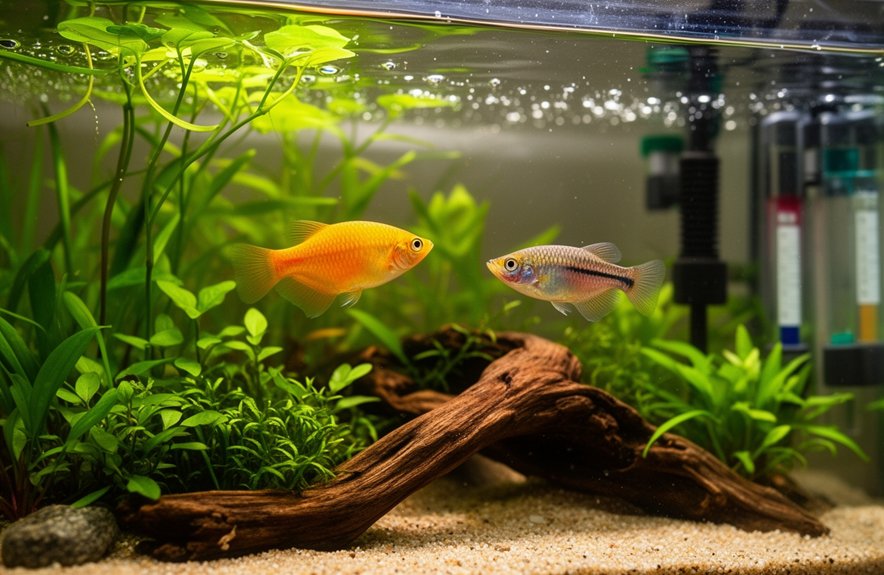
Gouramis do best in warm water kept around 24–28°C, with steady conditions that do not swing too much from day to day.
A pH between 6.0 and 7.5 usually works well for most species, and clean, well-filtered water helps them stay calm and active.
Gentle filtration is a smart choice, since these fish prefer a peaceful tank more than a brisk current.
Temperature: 24–28°C
For most dwarf and common gourami species, a steady aquarium temperature between 24–28°C (75–82°F) helps support normal metabolism, healthy immune function, and readiness to breed. A reliable heater and thermometer make temperature acclimation easier, and they keep the tank from wandering into trouble.
- Keep changes under ±1°C
- Raise to 27–28°C for breeding stimulation
- Adjust slowly over 24–48 hours
- Block drafts, lids, and window chill
- Match tankmates to similar warmth
Sudden drops can unsettle these social fish, so steady warmth helps the whole group feel secure, settled, and ready to thrive.
pH: 6.0–7.5
A steady pH between 6.0 and 7.5 gives most gourami species the slightly acidic to neutral water they prefer, and it helps them stay healthy, colorful, and settled.
| pH | Best use | Note |
|---|---|---|
| 6.0–6.5 | Breeding | Softer water can support bubble nests |
| 6.5–7.0 | Mixed tanks | Good middle ground |
| 7.0–7.5 | General care | Safe if stable |
| Weekly | Testing | Track water chemistry |
| Slow | Adjusting | Respect carbonate buffering |
Consistency matters more than chasing one perfect number, so changes should stay tiny. A reliable test kit, gentle dilution, and patience keep the group comfortable, with no pH drama.
Clean, well-filtered water
Gentle filtration works best, since strong currents can tire labyrinth fish and even wreck a bubble nest, which is a bit rude of a filter.
Clean, well-filtered water keeps gouramis settled and helps everyone in the tank feel at home.
- Use sponge or low-flow filtration
- Keep ammonia and nitrite at 0 ppm
- Hold nitrate below 20–40 ppm
- Change 20–30% of water weekly
- Quarantine new fish 2–4 weeks
Stable water chemistry matters, and a steady bacterial balance supports safe waste processing.
Aim for warm, calm water, and add new fish slowly to avoid sudden swings.
Feeding Tips
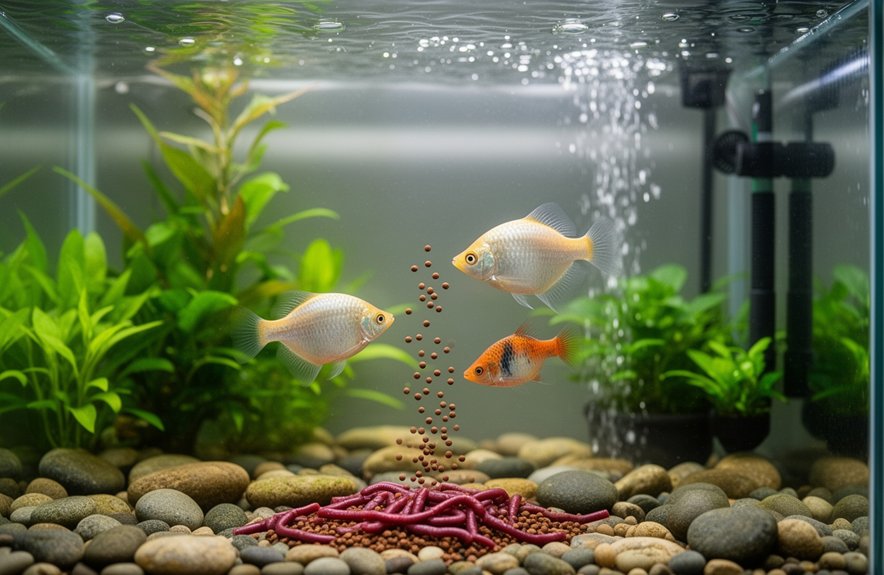
Gouramis do well with a varied omnivorous diet, so high-quality flakes or micro pellets can serve as a steady daily staple.
To keep meals interesting and balanced, add frozen or live foods like bloodworms, brine shrimp, and daphnia a few times each week.
This simple mix helps support good color, strong energy, and a happier fish at mealtime.
Omnivores (flakes, pellets, frozen food)
In most aquariums, gouramis do best as omnivores with a simple, varied menu, so high-quality flakes or pellets can serve as the daily staple, then frozen or live foods like bloodworms, brine shrimp, and daphnia can be offered several times a week. Their routine should feel easy to follow, with a little feeding enrichment from live algae and occasional vegetable matter.
- Floating foods help surface feeders
- Sinking bits reach midwater tankmates
- Small portions prevent overeating
- Feed once or twice daily
- Spirulina and carotenoids support color
Add variety like bloodworms or brine shrimp
A little extra variety can go a long way, and bloodworms or brine shrimp make useful treats for gouramis when used in moderation. These foods add seasonal variety, support nutrient balance, and can boost growth, color, and breeding condition.
Frozen bloodworms or brine shrimp work well once or twice a week, while baby brine shrimp suit fry and young gouramis in their first 1–3 weeks. Thaw frozen portions in tank water, blot off extra liquid, and offer only what fish finish in 2–3 minutes. Pair treats with flakes or pellets, and the tank stays tidier.
Behavior and Care Tips
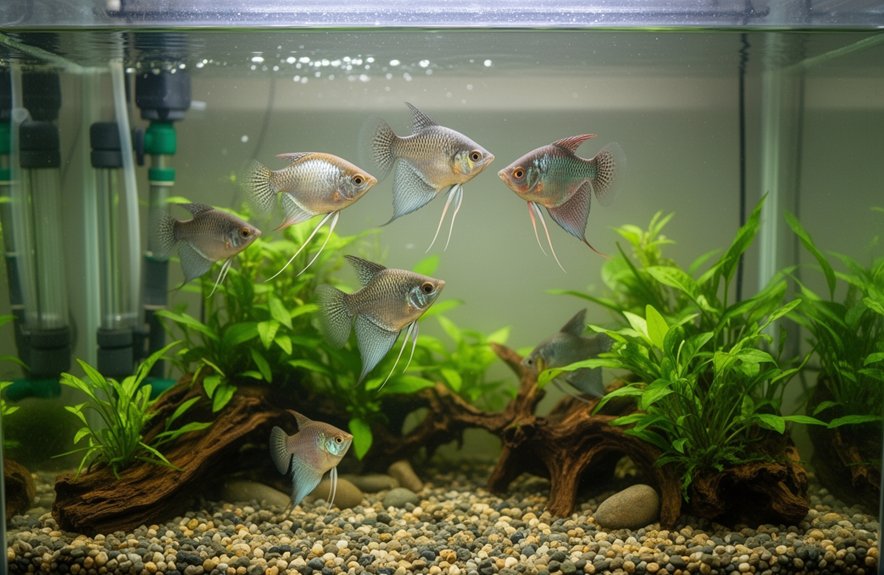
Male dwarf gouramis can be territorial, so it helps to keep their space calm, with one male per tank or plenty of room to separate rivals.
Hiding spots like plants, rocks, and driftwood give them places to rest and feel secure, which can lower stress.
A good setup keeps both open swimming space and thick planted areas, so the fish can roam without feeling exposed.
Males can be territorial
Few aquarium fish wear their confidence as boldly as a male dwarf gourami, and that same color can come with a territorial streak. In a small tank, one male usually works best, because territorial displays can turn into nipping, chasing, or worse.
During breeding aggression, guarding a bubble nest may make him even sharper.
- Keep one male in 10–20 gallons
- Avoid male bettas and other male labyrinth fish
- Watch for flared fins and pursuit
- Use dense plants to soften borders
- Rehome or upgrade if aggression stays strong
With space and calm tankmates, the tank feels safer for everyone.
Provide hiding spots
Among the simplest ways to help gouramis settle in is to give them places to slip out of sight, because a tank with dense live or artificial plants, floating cover, driftwood, and smooth caves feels closer to their natural plant-filled waters.
These hiding places should sit at different depths, with surface shade, midwater cover, and bottom retreats, so each fish can find its own spot.
Vertical tunnels, leaf litter, and gentle branches also create boundaries and nocturnal shelters.
In small tanks, aim for one well-planted refuge per fish, which can steady tempers and reduce fin nipping.
Keep plants and open swimming space balanced
For a gourami tank, the best setup is a careful mix of cover and open water, with about 60–70% of the sides and surface filled by rooted and floating plants like Java Fern, Cryptocoryne, and Water Lettuce, while leaving a clear central space for swimming.
- Build tall background plants.
- Keep midwater sightlines open.
- Use floating plant coverage lightly.
- Choose gentle filtration.
- Trim leaves before they crowd the surface.
This balance gives gouramis shaded retreats and easy cruising lanes, so they feel at home without turning the tank into a jungle maze.
Regular trimming also keeps air access open for their labyrinth breathing.
Common Mistakes to Avoid
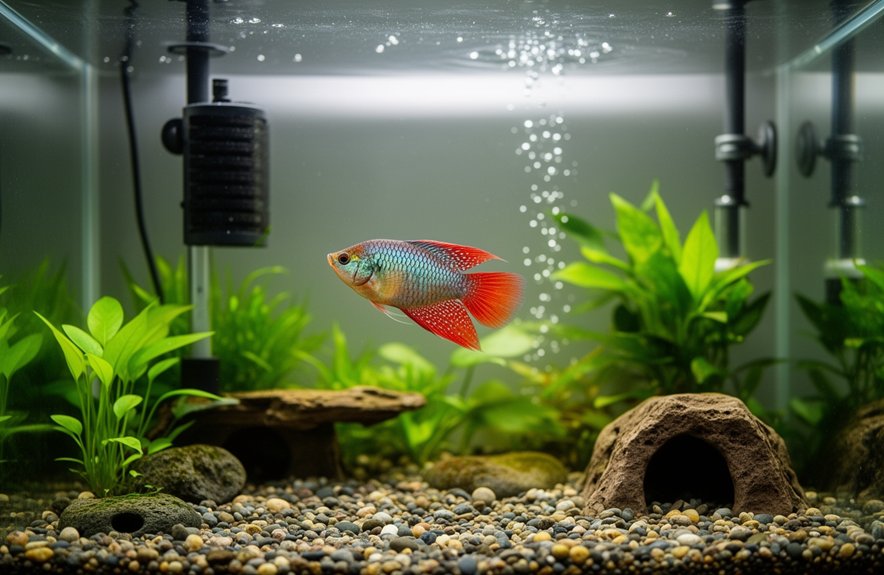
Common mistakes often start with water movement that is too strong, crowded tanks, and tankmates that are far too pushy for gouramis. A gentle filter, enough space, and peaceful companions help these fish stay calm and healthy, instead of spending their time battling the current or their neighbors.
With a few simple choices, the tank becomes a much better fit for them, which is usually the goal.
Strong filter flow
With strong filter flow, a gourami tank can quickly go from calm to exhausting, especially for dwarf and pearl gouramis that prefer slow to moderate movement. Gentle circulation, about 4–6 tank turnovers per hour, helps the fish feel settled and keeps bubble nesting on track.
- soften output with filter modifications
- aim spray bars toward glass
- add sponge pre-filters for safety
- use plants and floating cover
- break up current with diffusers
When flow stays brisk, fins tire, air access drops, and fry stay safer. A calm setup lets the whole group breathe easier.
Overcrowding
Crowded tanks can turn a calm gourami into a stressed one fast, especially when too many fish are packed into a small space.
A roomy setup supports schooling behavior cues, better breathing, and less oxygen depletion.
| Space | Safe load | Notes |
|---|---|---|
| 10 gal | 1 dwarf | Keep it simple |
| 20 gal | 1 dwarf | More room, less fuss |
| 55 gal+ | pair/large | Better for territories |
Overstocking lifts waste, so test weekly and change 25–50% when nitrate climbs. Keep open water, not a jungle gym, and feed in more than one spot so everyone gets a fair bite.
Mixing aggressive species
Mixing gouramis with the wrong tank mates can turn a peaceful setup into a scrap heap, so careful pairing matters. Their breeding behavior and calm nature are easily stressed by bullies.
- Skip tiger barbs and large cichlids.
- Do not mix with bettas or paradise fish without testing.
- Keep one male dwarf gourami unless the tank is large and planted.
- Match sizes, so tiny gouramis are not outmatched.
- Use hiding spots and floating plants to protect tank aesthetics and reduce tension.
Low stocking helps everyone settle in, feed safely, and feel like they belong.
Frequently Asked Questions
How Long Do Gourami Fish Usually Live in Captivity?
Gourami fish usually live 4 to 8 years in captivity, though lifespan variability depends on care, species, and water quality. With attentive husbandry, captive longevity can extend, helping owners feel part of a thriving aquarium community.
Can Gouramis Recognize Their Owners?
Like a face in a familiar café, gouramis can sometimes seem to know a keeper. They may show tank recognition through routine and owner bonding, associating people with food, safety, and gentle presence.
Do Gourami Fish Need a Heater Year-Round?
Yes, gourami fish typically need a heater year-round to maintain tropical warmth. Without one, temperatures can drift into seasonal cycling that stresses them. Stable heat helps them feel secure, comfortable, and part of a thriving tank community.
How Often Should Gouramis Be Quarantined Before Joining a Tank?
Gouramis should undergo a two week quarantine before joining a tank, like a guarded bridge to safety; this disease screening helps protect the whole community and lets each fish enter its new home with belonging.
What Signs Show a Gourami Is Ready to Breed?
A gourami is ready to breed when it builds a bubble nest and shows a color change, becoming brighter or deeper in tone. The fish may also display courtship behavior, signaling it feels secure and included.